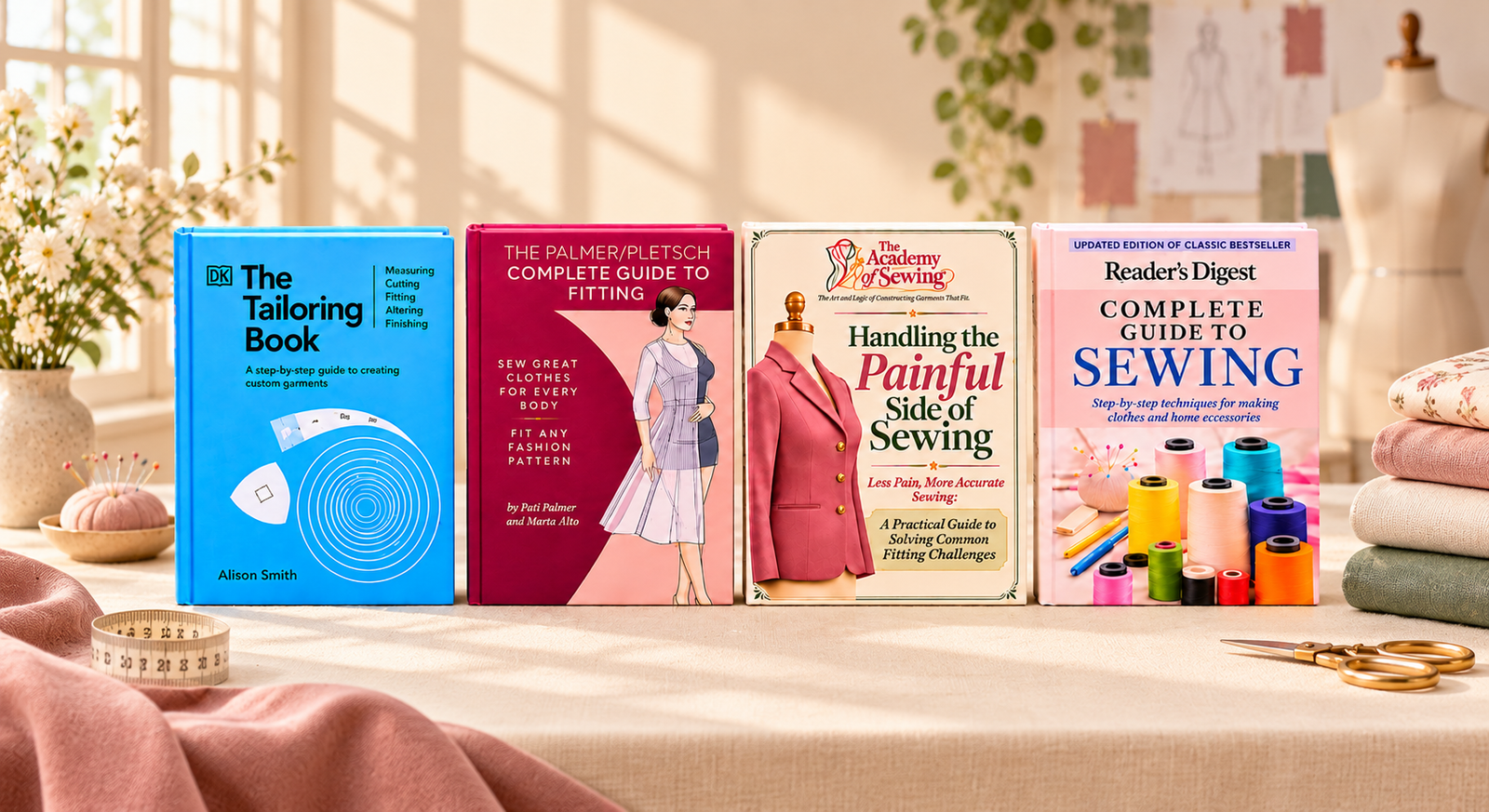
A pattern guide sheet explains how to sew one garment. It does not explain why a method works, what to change when your fabric behaves differently from the one the designer used, or how to alter a pattern that does not match your measurements. Those answers come from reference books, and a small set of well-chosen titles will settle most of the questions that come up at the machine.
This article sorts twelve books into four categories by the job each one does, shows how to match a problem to the right category, and gives an order for building the library so each purchase answers a question you actually have.
Match the Problem to the Category
Before you open any book, name the problem in one sentence. The category tells you which shelf to check first.
| Problem | Category | Check first |
|---|---|---|
| A technique you have not sewn before, such as a bound buttonhole or a lapped zipper | General Sewing References | The three general books |
| A garment that pulls, gapes, or wrinkles when worn | Fitting References | The four fitting books |
| A jacket, coat, or vest with a collar, lapels, and interfacing | Tailoring References | The three tailoring books |
| Cutting on a surface that is too low, or a room where nothing has a place | Sewing Space & Organization | The two space books |
General Sewing References
Three books cover the basic operations of home sewing: the Reader's Digest Complete Guide to Sewing, Simplicity's Simply the Best Sewing Book, and Sewing Essentials from the Singer Sewing Reference Library. Each one works as a first stop when you meet a technique you have not sewn before, such as a bound buttonhole, a lapped zipper, or a faced neckline.
Look up the operation, not the garment. Read the whole method before you cut, then gather the notions and tools the book lists. When the first explanation is unclear, read the same operation in a second book. Three books describe one technique in three sets of words and diagrams, and one of them will usually make sense where another does not.
When two books give different measurements, compare the garment design, fabric weight, curve and intended finish. Test the proposed hem depth on a scrap before choosing.
Fitting References
Four books address fitting: The Palmer Pletsch Complete Guide to Fitting, Fast Fit: Easy Pattern Alterations for Every Figure by Sandra Betzina, Threads Fitting for Every Figure, and Fitting and Pattern Alteration: A Multi-Method Approach by Elizabeth L. Liechty. This is the one category where owning more than one book pays off, because a single fitting problem can often be corrected by more than one method. Reading the same problem in two of these books shows you the alternatives, and the title of the Liechty book states that approach directly.
Pair fitting references with a test garment when possible. Identify a symptom, consult the relevant method, and test one correction at a time.
Tailoring References
Three books address tailoring: The Tailoring Book by Alison Smith, Tailoring from the Singer Sewing Reference Library, and Simple Tailoring & Alterations by J. François-Campbell. Tailoring uses methods that general references cover briefly, including shaping with interfacing, pressing to form curves, collars and lapels, and linings. These books slow down on those steps.
Add a tailoring reference when your next project calls for structured garments, such as a jacket, coat or vest. A book on alterations is useful when a finished garment needs adjusting.
Sewing Space and Organization
Two books deal with the room you sew in: Dream Sewing Spaces by Lynette Ranney Black and Setting Up Your Sewing Space by Myrna Giesbrecht. A studio that suits your body reduces the errors that come from tired hands and poor posture, and it affects accuracy as much as any technique does.
Set the cutting surface at a height that lets you work without prolonged bending. At the machine, adjust the chair and work surface so your shoulders relax, your elbows remain near your sides and your feet are supported. Leave sufficient clearance to move comfortably around the table.
Build the Library in Order of Need
Start with one general reference, one fitting reference and a third matched to your next project. Choose tailoring or sewing-space guidance according to your needs.
Add another book when you need a different explanation, technique or perspective.
For example, if a fitting sample pulls across the hip, consult a fitting reference to distinguish insufficient width from insufficient length or misplaced fullness. Test one correction before moving to another. See Common Garment Fitting Problems for a diagnostic approach.
Where to Find the Full List
The Books & Resources page on The Academy of Sewing lists all twelve titles with a description of each, so you can decide which one to buy first.
Explore the Books & Resources Collection
Disclosure: As an Amazon Associate, The Academy of Sewing may earn from qualifying purchases made through affiliate links, at no additional cost to you.