News & Events
What a Long Sewing Session Does to Your Body
No Comments
You sat down with a plan. A good pattern, the right fabric, enough time blocked off to actually make progress. Three hours later, your neck is stiff, your lower back is talking to you in ways it never used to, and your eyes feel like they have been rubbed with sandpaper.
This is not a complaint. It is a pattern, and it is one that shows up in sewing studios everywhere, in women who have been sewing for decades and love every minute of it. The physical cost of a serious sewing session is real, and it deserves a serious conversation.
The good news is that most of the discomfort sewists experience does not come from sewing itself. It comes from specific, identifiable conditions in the studio environment and in the body’s habits during a session. Once you understand what is actually happening, you can begin to address it.
Postural Problems Have a Direct Cause
The sewing machine creates a particular kind of physical demand. The work happens at close range, on a flat surface, with the hands occupied and the eyes locked forward. This pulls the body into a posture that was never designed to be held for long.
The head tilts slightly forward to see the needle. The shoulders round to bring the hands to the work. The lower back absorbs the resulting shift in the spine’s natural curve. Over an hour, then two, the muscles holding this position begin to fatigue. The discomfort that shows up in the neck, between the shoulder blades, or at the base of the spine is the body’s direct response to sustained unnatural positioning.
Chair height relative to machine height is one of the most commonly overlooked contributors. When the work surface is too high, the arms lift to reach it, which loads the trapezius muscles across the upper back and neck. When the chair is too low, the spine curves forward at the base, putting pressure on the lumbar region. Either imbalance creates cumulative strain that compounds across the length of a session.
The position of the presser foot pedal also matters more than most sewists realize. When the foot has to reach or angle awkwardly to operate the pedal, the resulting tension travels up through the hip, the lower back, and eventually the whole left side of the spine.
Poor Lighting Does More Than Strain the Eyes
Sewing requires sustained close-range visual focus. That alone is demanding. But the kind of lighting in the studio dramatically affects how hard the eyes and the surrounding muscles have to work to maintain that focus.
Overhead ambient lighting creates shadows directly at the point of work. The eyes compensate by straining to resolve detail in low contrast. The muscles around the eyes tighten. The forehead furrows. The jaw tenses. Over a long session, this pattern of subtle, unrelenting muscular effort contributes to headaches, eye fatigue, and tension through the face and neck that sewists often do not connect back to their lighting at all.
Color temperature matters alongside brightness. Light that is too warm makes it difficult to accurately read fabric colors and thread shades. Light that is too cool creates glare on pale fabric surfaces. Both conditions cause the eyes to work harder than they should, and both contribute to the kind of visual fatigue that becomes physical fatigue by the end of a session.
The direction of light is the third factor most sewists overlook. Task lighting positioned to the left of the machine works well for right-handed sewists because it prevents the working hand from casting a shadow over the needle area. Ceiling-mounted or directly overhead light sources almost always create exactly that problem.
Strategic Breaks Serve a Different Purpose Than Rest
Taking a break from sewing is not the same thing as stopping because you are tired. Strategic breaks serve a specific function: they interrupt the physical patterns that lead to cumulative strain before that strain becomes pain.
The body locks into posture. Muscles that have been held in one position for thirty or forty minutes begin to shorten and lose elasticity. Blood circulation in compressed areas decreases. The longer a position is held, the more effort it takes to release it, and the longer that release takes to feel complete.
A break taken at the point of fatigue is a recovery tool. A break taken before fatigue arrives is a preventive one. The difference in outcome is significant, and most sewists have only ever experienced the first kind.
What happens during a break matters as much as when it happens. Leaving the studio to check a phone or walk to the kitchen does not address the specific muscular patterns that have built up at the machine. Targeted movement that counteracts the forward, rounded, contracted position of sewing is what creates actual relief and restores the conditions that make the next session possible.
The Complete Picture Requires a Complete System
Understanding that posture, lighting, and breaks all contribute to physical discomfort is a solid starting point. But each of these factors connects to the others, and addressing one in isolation rarely produces lasting results.
The sewist who adjusts her chair height but sits under a single overhead bulb for four hours without interruption is still going to finish the session in pain. The sewist who takes regular breaks but returns each time to a machine positioned at the wrong angle is accumulating the same strain she is periodically releasing.
A complete approach to pain-free sewing addresses all of these elements together, in a way that fits into how sewists actually work rather than asking them to rebuild their entire studio or restructure their creative process.
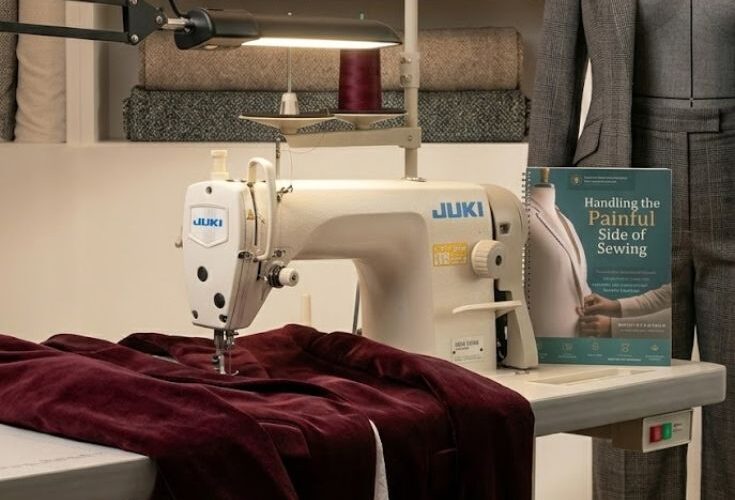
That complete approach is exactly what the guide Handling the Painful Side of Sewing was built to provide.
Discover the Complete System for Pain-Free Sewing