News & Events
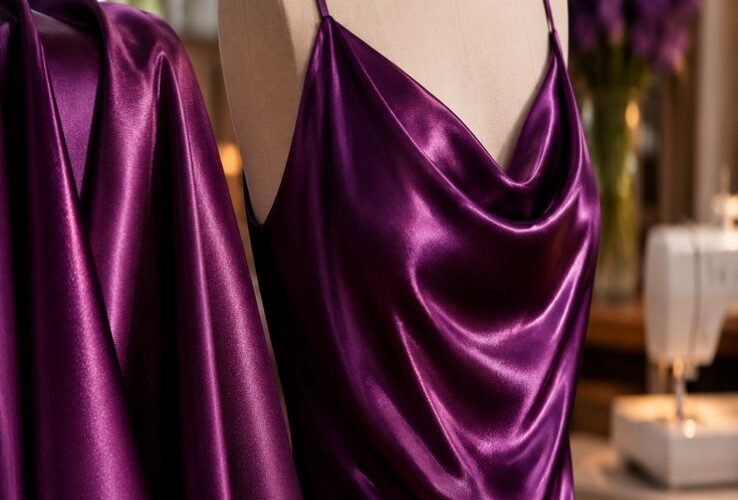
Satin makes a lot of sewists nervous, and I understand why. It slips, it snags, it shows every needle hole, and a single drop of water can leave a mark. The good news is that almost all of those problems come down to a few choices you make before you sew a single seam: the needle, the presser foot, a test scrap, and how you handle the iron. This guide covers all of it so you can choose the right satin for your project and sew it without wasting fabric.
First, a quick point that clears up a lot of confusion. Satin is a weave, not a fiber. The weave leaves long threads floating across the surface, which gives you that smooth, shiny face and a duller back. Satin can be made from silk, polyester, rayon, acetate, or nylon, so two satins from two different bolts can sew and wash very differently. Find out what yours is made of before you do anything else.
Quick Reference
Keep this handy while you sew. Each item is explained in the sections below.
| What you need | Regular woven satin | Stretch satin |
|---|---|---|
| Needle type | Microtex or Sharp, brand new | Stretch or Ballpoint, brand new |
| Needle size | 60/8 to 70/10 for light satin, 80/12 for heavy satin | 75/11 |
| Thread | Fine 100% polyester or fine silk | Fine 100% polyester |
| Stitch | Straight stitch | Narrow zigzag or lightning stitch |
| Stitch length | 2.0 to 2.5 mm | 2.5 to 3.0 mm |
| Presser foot | Walking foot, dual feed, or Teflon foot | Walking foot, dual feed, or Teflon foot |
| Iron | Low to medium, dry heat, depends on fiber | Low, synthetic setting |
The Types of Satin
Not all satin is the same, and choosing the right type for your garment matters as much as choosing the pattern. Here is how the four main types compare.
| Type | What it’s like | Needle size | Best for |
|---|---|---|---|
| Charmeuse | Very lightweight and fluid, shiny face, matte back | 60/8 to 70/10 | Slip dresses, bias-cut skirts, blouses, lingerie, camisoles |
| Crepe-back satin | Medium weight, shiny face, bumpy matte back | 70/10 to 80/12 | Evening gowns, cocktail dresses, draped dresses, soft jumpsuits |
| Duchess satin | Heavy and crisp, holds its shape | 80/12 | Ballgowns, tailored evening jackets, corsets, pleated formal skirts, bridalwear |
| Stretch satin | Woven satin with 2% to 5% spandex | 75/11 stretch | Body-con dresses, fitted gowns, performance wear, dancewear |
Charmeuse is the one most people picture, and it is also the slipperiest, so give it extra patience. Crepe-back satin gives you two looks from one fabric, because you can use either the shiny side or the textured side as the right side. Duchess satin is thick enough that it doesn’t slide around much, but the weight means you need a stronger needle and well-finished seams. Stretch satin needs a stretch needle and a stitch that gives, or your threads will pop when the fabric moves.
Satin vs. Sateen
Sateen looks a lot like satin, but it is usually made from cotton. It has a soft sheen instead of a high gloss, it is far less slippery, and it handles a hotter iron. It is much easier to sew, so don’t assume a satin tip applies to sateen or the other way around.
What Your Satin Is Made Of
The fiber decides how you prewash it, how hot your iron can be, and how you care for the finished garment.
- Silk satin is a natural fiber. It breathes well and has a beautiful drape.
- Rayon (viscose) satin is plant-based, breathable, and soft with a fluid drape. It loses a lot of strength when wet, so be gentle when you wash it.
- Polyester and nylon satin are durable, but they don’t breathe well and can feel warm to wear. They are also sensitive to a hot iron.
- Acetate satin doesn’t breathe, melts easily under heat, water spots, and is dry clean only. It’s a good fit for formal pieces that won’t be washed often.
Prewash and Shrinkage
Prewash your satin the same way you plan to care for the finished garment. That lets the fabric shrink before you cut and removes surface finishes. The numbers below are approximate, so cut a small swatch, measure it, wash it, and measure it again to know exactly what your fabric does.
| Fiber | Approximate shrinkage | Prewash | Care for the finished garment |
|---|---|---|---|
| Silk | 3% to 5% | Hand wash cold or dry clean a test swatch | Dry clean or hand wash gently, air dry flat |
| Rayon | 5% to 10% | Hand wash cold and air dry. Don’t skip this one, because wet rayon is fragile | Hand wash cold or gentle cycle, air dry |
| Polyester | 0% to 2% | Machine wash cold, line dry | Machine wash cold on gentle, tumble dry low |
| Acetate | 2% to 5% | Dry clean only, no water | Dry clean only |
Pressing Satin
Use low to medium heat, depending on the fiber, and press from the wrong side with a dry press cloth between the iron and the fabric. Press down and lift instead of sliding the iron back and forth, because sliding can stretch and distort the seams. Water and steam can leave permanent spots, so test on a scrap first. Some silk satins handle a little steam, but polyester and acetate can spot or shrink right away.
Choosing the Right Garment
Satin shines when you let it do what it does best, which is drape.
- Bias-cut pieces like slip dresses and skirts follow the body beautifully.
- Fluid styles such as cowl necklines, flared skirts, gathered sleeves, soft blouses, evening gowns, and robes show off the drape.
- Structured formals like ballgowns, tailored evening jackets, corsets, and pleated skirts are the job for duchess satin.
Skip satin for casual utility wear and activewear, because it doesn’t hold up to rubbing and rough use. I’d also avoid tight, structured pants or anything like jeans in regular woven satin. The seams will pull apart under constant strain.
Interfacing
Choose an ultra-lightweight fusible interfacing or sew-in silk organza. Heavy or crisp fusibles take away the drape that makes satin worth using, and they can bubble or bleed adhesive through to the shiny surface. Test-press any fusible on a scrap before it goes anywhere near your garment.
Pattern Choice, Fit, and Seam Allowance
Pick the right pattern. Choose a pattern designed for drapey woven fabric, or a stretch knit pattern if you’re using stretch satin. Stay away from designs with lots of seams, since every seam is another chance for slipping, fraying, and needle holes.
Allow extra ease. Woven satin doesn’t give, and synthetic satins don’t breathe. Seams under strain can slip, which means the threads pull away from the stitching line and leave a gap. Add some extra ease to woven satin garments and avoid skin-tight fits unless you’re using stretch satin.
Cut wider seam allowances. The standard 5/8 inch (1.5 cm) can be too narrow for satin that frays a lot. Use 3/4 inch (2 cm) or more. If you plan on French seams, add even more width when you lay out and cut.
Tools and the Scrap Test
Your Tool Checklist
- Machine needle: Put in a brand-new Microtex or stretch needle. Even a slightly dull tip will pull threads and leave snags you can’t fix.
- Hand needle: A size 9 to 10 straw or milliners needle. The long, fine shaft leaves very small holes when you hem by hand.
- Presser foot: A walking foot or dual feed foot keeps the top layer from creeping ahead of the bottom layer.
- Cutting: A rotary cutter and mat, or sharp serrated shears with tissue paper under the fabric. Use pattern weights instead of pins through the pattern.
- Pins: Extra-fine silk pins, placed only inside the seam allowance.
- Marking: Thread-traced tailor’s tacks are the safest. Test chalk or water-soluble markers on a scrap first.
The 4-Step Scrap Test
Before you cut your garment, test your whole setup on a folded scrap of the same fabric.
- Needle and stitching. Check for pulled threads, skipped stitches, or snags.
- Tension and stitch length. Try 2.0 to 2.5 mm for woven satin or 2.5 to 3.0 mm for stretch satin, and adjust the tension until the seam lies flat without puckering.
- Marking tools. Mark the scrap with the tool you plan to use and check for a ring, ghost line, or stain that won’t come out.
- Pressing and steam. Test your iron temperature, your press cloth, and how the fabric reacts to steam.
This takes ten minutes, and it can save you from ruining the fabric you bought for the garment.
Sewing Your Satin
Sew with care. Needle holes in satin are permanent, so seam ripping is a last resort. Measure twice and sew once.
Hold the fabric taut. Apply light tension with your hands in front of and behind the presser foot as you sew. Don’t pull hard, just enough to keep the seam flat.
Seam Finishes
Satin frays, so finish every raw edge.
- French seams work well for unlined, lightweight garments because they enclose the raw edges.
- Hong Kong finish (wrapping the raw edge in bias binding) is a good choice for unlined jackets and heavier satins.
- Serging or overlocking the edges before you assemble the garment works for fabric that frays heavily.
Hems
- Narrow rolled hem or baby hem: best for light, fluid satins like blouses and slip skirts. A baby hem is stitched 1/8 inch from the edge, trimmed close, folded over, and stitched again.
- Hand-rolled hem: a lovely finish for silk garments and scarves, done with a size 9 to 10 straw needle.
- Blind hem or hand-stitched hem: the usual choice for heavy satins and formal dresses, since the stitches don’t show on the right side.
Fixing Common Satin Problems
| Problem | Why it happens | What to do |
|---|---|---|
| Puckered seams | Tension too tight, stitch too short, or the fabric is dragging under the foot | Switch to a walking foot, lengthen the stitch a little, hold the fabric taut, and check your thread weight |
| Skipped stitches | Wrong needle or a dull tip | Put in a brand-new Microtex needle for woven satin or a stretch needle for stretch satin |
| Snags and pulled threads | A burred needle, a rough foot or feed dogs, or pins | Change the needle, check the foot for burrs, pin only inside the seam allowance, and check for rough fingernails |
| Layers sliding | Smooth fabric on smooth fabric has no grip | Use a walking or Teflon foot, put tissue paper under the layers, and cut with pattern weights |
| Water spots or dull patches | Steam, water drops, or an iron that is too hot | Press dry from the wrong side with a press cloth, and test steam on a scrap |
| Seams gapping | Too much strain on the fine threads at the seamline | Add ease, use 3/4 inch seam allowances or wider, and reinforce stress seams with lightweight seam tape |
Before You Cut
- Know your fiber and your type of satin.
- Prewash a swatch and measure the shrinkage.
- Put in a brand-new needle and use a walking or Teflon foot.
- Run the 4-step scrap test.
- Cut with pattern weights and finish every raw edge.
[…] The Academy of Sewing’s fiber data shows shrinkage of 3 to 5% for silk, 5 to 10% for rayon, 0 to 2% for polyester and 2 to 5% for […]